|
IGOR
LUPESCU
Please use our
Ancient Egyptian A-Z
to
navigate the antiquities on this site or revisit HOME
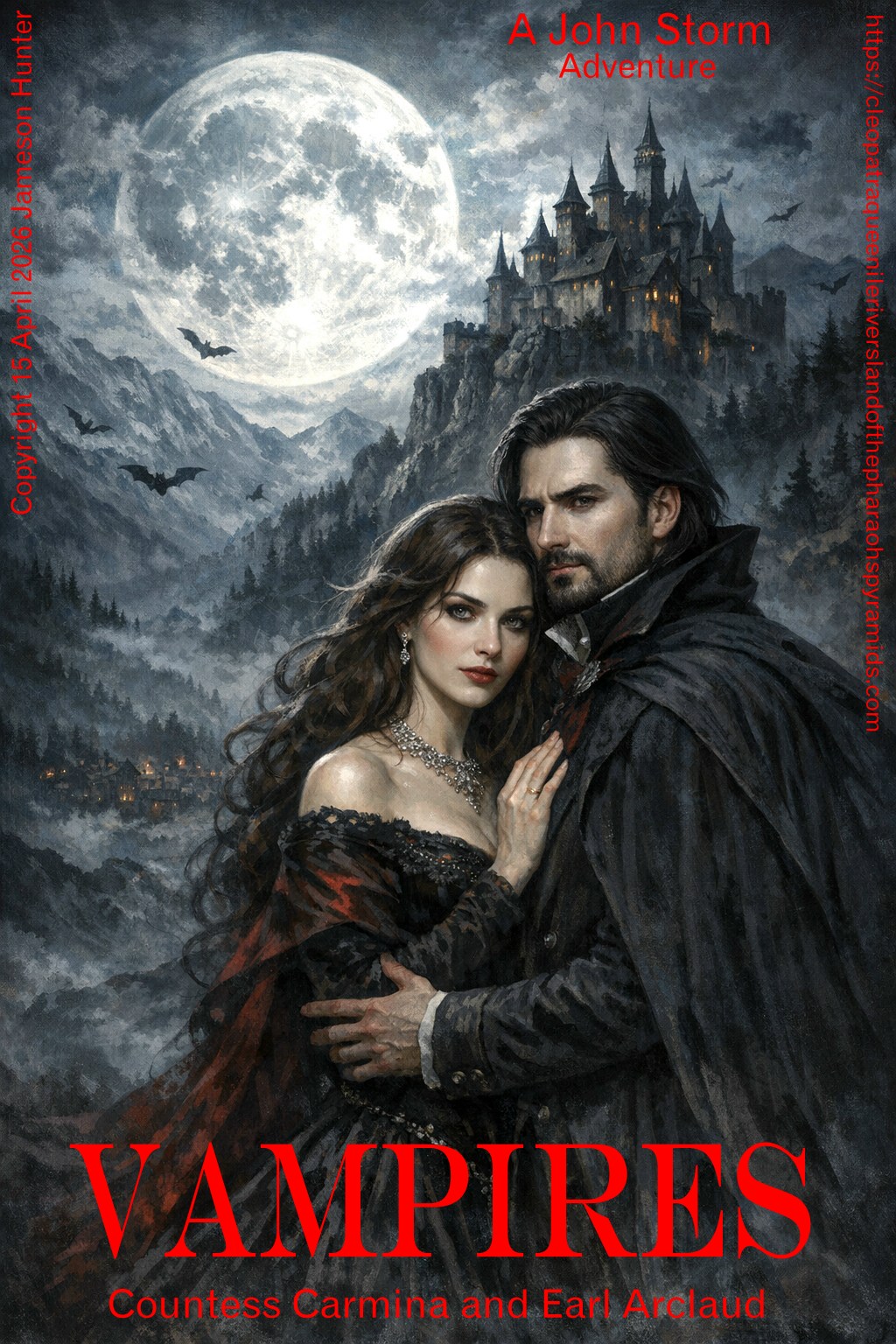
The John
Storm Franchise, is a series of original "climate and
ocean" awareness stories being developed as graphic
novel and
screenplay adaptations. This is the 5th iteration of the
Vampire theme, with romantic horror overtones, as a distinguished
Carpathian scientist sets out to discover why ancient Egyptians believed
in life after death. The
original Count Dracula was created by the Irish
writer Bram
Stoker.
IGOR LUPESCU — THE MAN WHO SERVES IN SHADOWS
Igor Lupescu had not been born into servitude. In the mountain village of Călata, where the Carpathians rose like ancient guardians and the winters carved hardship into every face, he had once been known as a bright, capable boy. His mother said he had the hands of a healer; his father insisted he had the shoulders of a shepherd. But fate had other plans, and the world had little mercy for a child born with a twisted spine and a constellation of warts across his cheek that no village remedy could cure.
Children mocked him. Adults pitied him. Only the mountains treated him without judgement.
He grew up learning to move quietly, to listen more than he spoke, and to read the moods of others with uncanny precision. When he was old enough, he left the village with nothing but a threadbare coat and a stubborn belief that somewhere beyond the peaks, he might find a place where his worth was measured by loyalty rather than appearance.
He crossed borders the way others crossed streets — silently, unnoticed, carrying with him the resilience of a man who had survived ridicule and hunger. By the time he reached England, he had worked as a porter, a night watchman, a caretaker of old estates whose owners barely remembered his name. But he remembered theirs. He remembered everything.
It was in London, during a bitter winter, that he first encountered Earl Arclaud.
The Earl had collapsed in a narrow alley behind a theatre, pale as moonlight, trembling with a sickness that no doctor could diagnose. Igor, returning from a late shift, recognised the signs — not of illness, but of something older, something whispered in the stories of his homeland. He carried the Earl home, tended to him through the night, and when dawn came, the Earl awoke with the clarity of a man who had glimpsed death and returned.
That morning forged a bond neither spoke of openly.
The Earl, recognising Igor’s discretion and quiet strength, offered him employment. Igor accepted, though he suspected the Earl’s offer was less charity and more necessity. For Igor had seen the small silver vial the Earl clutched in his weakened hand — the silver salts, a remedy known only to a few families in the Carpathians, whispered to suppress a dormant affliction that should never be named aloud.
Igor knew the stories. He had heard them as a child, sitting by the hearth while the elders spoke of noble houses cursed by ancient blood, of lords who walked the night, and of remedies that kept the darkness at bay. He had never believed them fully — until he saw the Earl’s eyes in the half‑light, reflecting a hunger that was not human.
The Earl did not ask Igor to swear secrecy. Igor swore it of his own accord.
In return, the Earl gave him what no one else ever had: security, respect, and purpose. A generous salary, a warm room, and the assurance that his afflictions — his bent spine, his warts, his awkward gait — mattered far less than his loyalty.
Igor became more than a servant. He became the Earl’s shadow, his confidant, the silent guardian who ensured the silver salts were always prepared, always measured, always ready before the Earl’s strength faltered. He learned the rhythms of the Earl’s condition, the subtle signs of strain, the moments when the old blood stirred beneath the surface.
And when the Countess fell ill — when the virus awakened the dormant curse in her veins — Igor was the first to understand the danger. He saw the fear in the Earl’s eyes, the desperation of a man who had already lost too much to the past.
Igor said nothing. He simply stood a little closer, moved a little faster, and prepared himself for the storm that was coming.
For Igor Lupescu had spent his life in the shadows. And now, in the service of the Earl, he had finally found a shadow worth standing in.
THE
ILLUMINATI
Bavarian secret society founded in 1776, organized like the Freemasons. new order was Bund der Perfektibilisten, or Covenant of Perfectibility (Perfectibilists); he later changed it because it sounded too strange. On 1 May 1776, Weishaupt and four students formed the Perfectibilists, taking the Owl of Minerva as their symbol. The members were to use aliases within the society. Weishaupt became Spartacus. Law students Massenhausen, Bauhof, Merz and Sutor became respectively Ajax, Agathon, Tiberius and Erasmus Roterodamus. Weishaupt later expelled Sutor for indolence. In April 1778, the order became the Illuminatenorden, or Order of Illuminati, after Weishaupt had seriously contemplated the name Bee order.
AGE OF ENLIGHTENMENT
The Age of Enlightenment or the Enlightenment, also known as the Age of Reason, was an intellectual and philosophical movement that occurred in Europe, especially Western Europe, in the 17th and 18th centuries, with global influences and effects. The Enlightenment included a range of ideas centered on the value of human happiness, the pursuit of knowledge obtained by means of reason and the evidence of the senses, and ideals such as natural law, liberty, progress, toleration, fraternity, constitutional government, and separation of church and state.
The Enlightenment was preceded by the Scientific Revolution and the work of Francis Bacon and John Locke, among others. Some date the beginning of the Enlightenment to the publication of René Descartes' Discourse on the Method in 1637, featuring his famous dictum, Cogito, ergo sum ("I think, therefore I am").
NEW WORLD ORDER
The New World Order (NWO) is a conspiracy theory that hypothesizes a secretly emerging totalitarian world government. The common theme in conspiracy theories about a New World Order is that a secretive power elite with a globalist agenda is conspiring to eventually achieve world domination and rule the world through an authoritarian one-world government—which will replace sovereign nation-states—and an all-encompassing propaganda whose ideology hails the establishment of the New World Order as the culmination of history's progress. Many influential historical and contemporary figures have therefore been alleged to be part of a cabal that operates through many front organizations to orchestrate significant political and financial events, ranging from causing systemic crises to pushing through controversial policies, at both national and international levels, as steps in an ongoing plot to achieve world domination.
Before the early 1990s, New World Order conspiracism was limited to two American countercultures, primarily the militantly anti-government right, and secondarily the part of fundamentalist Christianity concerned with the eschatological end-time emergence of the Antichrist.
|